
Empowering smart homes by IoT-driven hybrid renewable energy integration for enhanced efficiency
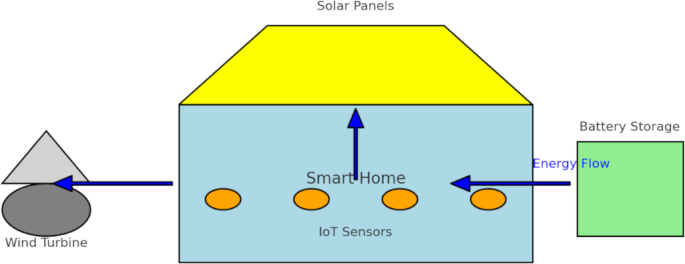
The strategy for interfacing IoT with hybrid renewable energy systems in smart homes involves several essential steps, including system design, data collection, optimization algorithms, and performance evaluation. This section outlines all steps and presents a mathematical model that supports any energy management strategy.
System design
-
Solar Energy Production: Power generation is parametrically modeled using solar irradiance(W/m²), panel efficiency, and area to calculate PV output.
$${P_{solar}}\left( t \right)={I_{solar}}\left( t \right) \times {A_{solar}} \times {\eta _{solar}}$$
(1)
The solar energy production Eq. (1) calculates the energy generated by solar panels at a given time, \(\:P\)solar. \(\:I\)Solar(t) is the solar irradiance (W/m²) at the time \(\:t\), representing the sunlight intensity on the panel surface. \(\:A\)Solar is the area of the solar panels (m²), determining the amount of sunlight they can capture. The equation assumes stable irradiance and solar panel efficiency\(\:\:\eta\:\)solar during the measurement interval and that the solar panel angle is optimal for capturing sunlight.
-
Wind Energy Production: Energy production is based on wind speed (m/s), wind turbine characteristics, and power curves to account for time-varying wind contributions.
$${P_{wind}}\left( t \right)=0.5 \times {\rho _{air}} \times {A_{wind}} \times {V^3}_{{wind}} \times {\eta _{wind}}$$
(2)
The wind energy production Eq. (2) calculates the power generated by a wind turbine at a given time, \(\:P\)wind(t). It depends on the air density\(\:\:\rho\:\)air, the area swept by the turbine blades\(\:\:A\)wind, the wind speed at that moment\(\:\:V\)wind(t), and the turbine’s efficiency\(\:\:\eta\:\)wind.The equation assumes steady wind conditions and optimal turbine orientation, with efficiency influenced by factors such as blade design and turbine placement.
$${P_{total}}\left( t \right)={P_{sola}}r\left( t \right)+{P_{wind}}\left( t \right)$$
(3)
Equation (3) calculates the total energy production \(\:P\)total(t) from solar and wind sources at any given time \(\:t\). It represents the sum of power generated by solar panels and wind turbines. This model assumes that both energy sources operate independently and under optimal conditions, with steady irradiance and wind speed at time \(\:t\).
-
Energy Storage Dynamics: Describes battery charging and discharging behavior, state of charge (SoC), and efficiency losses to ensure reliable backup.
$${B_{level}}\left( {t+1} \right)={B_{level}}\left( t \right)+{P_{total}}\left( t \right) – {E_{consumption}}\left( t \right) – {E_{grid}}\left( t \right)$$
(4)
Equation (4) demonstrates updating the battery charge \(\:B\)level(t) by considering the power input and the interaction of energy exchange \(\:E\)grid(t) from the grid with time \(\:t\). This dynamic equation is also critical for controlling the state of charge when co-optimizing renewable generation and power grid interactions. The battery will be correctly charged or discharged according to different system price signals.
-
Energy Balance: The energy management system aims to optimize the balance between energy production, storage, and consumption. The following mathematical model:
$$\left\{ {\begin{array}{*{20}{l}} {{P_{total}}\left( t \right) \geqslant {E_{consumption}}\left( t \right)+{E_{storage}}\left( t \right)if~{B_{level}}\left( t \right)<{B_{max}}} \\ {{P_{total}}\left( t \right)+{E_{grid}}\left( t \right) \geqslant {E_{consumption}}\left( t \right)if{~_{Blevel}}\left( t \right)={B_{max}}} \end{array}} \right\}$$
(5)
Equation (5) serves as a foundation for enabling the energy management system to allocate resources and maintain optimal power consumption and storage flexibly. The energy balance Eq. (5) represents the goal of the energy management system: to optimize the balance between total energy production \(\:E\)produced(t), storage \(\:E\)stored(t), and consumption \(\:E\)consumed(t). This model assumes that energy production and demand fluctuate over time and that storage is available to buffer supply and demand variations, thereby enhancing system efficiency and reliability. The balance aims to minimize waste and improve self-sufficiency in energy usage.
Data collection
The data collected in the work includes all the relevant information for a holistic picture of energy production, consumption, and the environment in a smart home and a hybrid IoT-based renewable energy system. Several environmental and energy aspects are subject to continuous monitoring by the IoT sensor reporting, whereas user communication with the system is the only non-automated measurement. Data collection is the most essential part of this assessment, as it will help evaluate the performance of the IoT-integrated hybrid renewable energy system in smart homes. This study consistently tracks and analyzes the following metrics:
a). Energy produced: This metric shows daily energy from solar panels and wind turbines. Solar energy production is calculated based on solar irradiance data, and the panel’s efficiency is expressed in kWh. This metric is measured in kWh and was calculated using wind speed data and turbine capacity. This metric is used for renewable energy generation, including volume and patterns, as well as supporting load-balancing strategies.
b). Energy Consumption: Cumulative energy consumption of the smart home, considering all the connected devices and appliances. The power consumption (kWh) is calculated by summing the outputs (power usage) and the input power of the heating, ventilating, and air-conditioning system to understand the total energy consumption and identify opportunities for load shifting and peak shaving.
c). Energy Storage: Data relevant to battery functionality—the amount of charge and discharge cycles and the state of charge (SOC). The charging level indicates the remaining battery capacity as a percentage, along with the number of complete charge/discharge cycles during the study period. Energy Storage evaluates the storage system’s efficiency and its role in balancing energy supply and demand.
d). Environmental Conditions: Real-time data on environmental parameters that affect renewable energy generation. Temperature in Celsius (°C) affects solar panel performance. Wind Speed impacts wind turbine output and is measured in meters per second (m/s). Solar energy is measured in terms of potential in watts per square meter (W/m²). This metric correlates environmental factors to renewable energy production for predictive modelling and optimization.
e). System Performance: Assess the overall performance of the integrated energy system. The total amount of renewable energy, including electric energy from renewable sources, is consumed. First is the system efficiency, which indicates that the system converts renewable energy into usable power.
f). User Satisfaction: Survey data relating to user ratings for the usability and performance of the system. The Satisfaction Score, ranging from 1 to 10, is based on user feedback regarding comfort, control, and cost savings. It investigates the human side of the smart energy system and identifies the components that require adjustments to ensure user satisfaction.
The following data collection metrics form the basis of the analytical study, assessing the technical performance and user satisfaction of the IoT-enabled hybrid renewable energy system. All metrics directly relate to the system’s reliability, efficiency, and sustainability.
Optimization algorithms
Optimization algorithms are advanced computational procedures used to determine energy consumption cost minimization in smart home systems. This analysis utilizes real-time data and user behavior algorithms to optimize energy consumption, thereby significantly reducing costs and enhancing system efficiency. This optimization model is developed to minimize the total cost of energy consumption with the following objective function:
$$C=\sum\limits_{{t=1}}^{T} {[Cgrid \cdot Egrid\left( t \right)+Cmaintenance]}$$
(6)
Equation (6) defines the total cost C of energy consumption in a period of T; the cost depends on the cost of energy from the grid and the time step t. The cost from time step t is the sum of the energy consumption from the grid multiplied by the cost per unit of grid energy, \(\:C\)grid, and the energy consumption from the grid \(\:E\)grid(t). Maintenance cost \(\:C\)maintainance of the renewable energy system is assumed to be constant or variable over time. This cost is summed over the time intervals t, resulting in a total cost for the entire period T that an optimization algorithm can minimize by modifying a grid energy consumption variable or entries for renewable energy strategies or storage strategies.
Demand response strategy
The demand response uses peak shaving, shifting energy consumption from peak to off-peak periods. It shifts flexible loads, helping to stabilize the grid and lower energy costs. Reduce energy consumption during peak demand by shifting usage to off-peak times.
$$Minimize\sum\limits_{{t \in peak}} {{E_{consumption}}\left( t \right)}$$
(7)
Where t∈ peak is the peak demand period, shift energy consumption to off-peak periods by rescheduling flexible loads:
$${E_{consumption}}\left( t \right)={E_{fixed}}\left( t \right)+{E_{flexible}}\left( t \right)$$
(8)
$${E_{{flexible}}(t)=\{^{0}_{E}}_{flexible}\:(t) \:_{{otherwise}}^{{ift \in peak}}$$
(9)
Equations (7), (8), and (9) are conceptually known as peak shaving, whose implementation is widely applied in demand response to mitigate energy consumption during peak demand hours. In Eq. (7), t∈peak indicates the periods within peak demand. Equation (8) concerns rescheduling flexible loads, energy-consuming activities, or devices that could be moved in time without affecting their operation for off-peak periods, thus reducing energy consumption in high grid prices or demand. As described in Eq. (9), the total energy consumption consists of an inflexible baseline consumption. This energy will provide critical loads that cannot be shifted, as well as the adjusted flexible loads. This aims to “flatten the curve” of energy demand, thereby reducing peak loads, which in turn can help decrease energy costs while ensuring that basic energy needs are met.
$$Minimize\sum\limits_{{t=1}}^{T} {(\frac{{\left( {{E_{consumption}}\left( t \right) – \overline {{{E_{consumption}}}} } \right)}}{{\overline {{{E_{consumption}}}} }}} {)^2}$$
(10)
Equation (10) is designed for load balancing, aiming to distribute energy consumption evenly within a period T to prevent system overload. The objective is to reduce variability in energy use by keeping consumption as close as possible to the average energy consumption for the period. After summing the total energy for T time intervals and dividing it by T, the average energy consumption will be calculated as the spread load. This helps stabilize the grid, mitigates the risk of sudden demand spikes, and enhances energy efficiency.
Battery health monitoring
Battery charging, temperature tracking, and battery health monitoring. Using smart algorithms, real-time data protects against overcharging and deep discharging. The system enhances battery efficiency by operating under ideal conditions, enabling dependable energy storage and sustainable operation of smart home energy systems. Monitor battery charge cycles and temperature to extend lifespan.
$$Monitor~{N_{cycles}}=\sum\limits_{{t=1}}^{T} {\delta {B_l}_{{evel}}\left( t \right)}$$
(11)
Equation (11) illustrates the shifts in battery charge levels over time, which are monitored to track effective battery charge cycles. Here, Blevel(t) indicates the full battery charge at time t, and δBlevel(t) measures the change in battery state per unit time. These inconsistencies serve as input, enabling the system to learn and anticipate battery degradation by managing charge and discharge cycles, thus avoiding overcharging or deep discharge, which can shorten the battery’s lifespan. This helps manage the energy storage system effectively without compromising system controllability.
$$Monitor~{T_{battery}}\left( t \right)$$
(12)
Equation (12) focuses on battery health, ensuring it remains within the operating temperature limits [Tmin, Tmax]. The battery temperature Tbattery(t) is tracked at each time t. The control system will initiate corrective measures, such as adjusting the charging rate or deactivating the cooling and heating systems. This ensures real-time monitoring to prevent thermal stress, which reduces the risk of overheating or freezing and thus helps protect battery performance and increase lifespan.
$${B_{min}} \leqslant {B_{level}}\left( t \right) \leqslant {B_{max}}$$
(13)
Equation (13) protects battery health by avoiding overcharging and deep discharging. The battery charge level, Blevel(t), is continuously monitored. The controller actuates the system, ensuring Blevel(t) is within a safe operating band [Bmin, Bmax]. Charging is stopped when Blevel(t) exceeds Bmax to prevent overcharging, which can cause overheating and capacity loss. If, however, Blevel(t) < Bmin, discharge is terminated, which prevents the battery cells from being deeply discharged, as this is harmful. These algorithms keep the battery efficient and maximize its lifespan.
Performance evaluation
The performance evaluation measures energy savings, CO₂ emissions reduction, and the efficiency of the entire system based on comparing the energy cost and output-input ratio, which highlights the impact of renewable energy in smart homes. The performance of the system is based on the following :
-
Energy Savings: Transitioning to renewable energy sources can significantly lower energy expenses and diminish CO₂ emissions by substituting fossil fuels with more sustainable alternatives. The energy savings are enhanced by increased system efficiency, ensuring that each unit of energy produced is fully utilized.
$$Energy~Savings=\frac{{Cost~of~traditional~system – Cost~of~IoT\_based~system}}{{Cost~of~traditional~system}} \times 100\%$$
(14)
$$System~Efficiency=\frac{{Total~Energy~Output}}{{Total~Energy~Input}} \times 100\%$$
(15)
$$Emissions~Reduction=\frac{{Emissions~of~traditional~system – Emissions~of~IoT\_based~system}}{{Emissions~of~traditional~system}} \times 100\%$$
(16)
Equations (14), (15), and (16) evaluate the performance of a renewable energy and storage integrated energy system. These equations calculate the system’s energy savings, CO₂ emissions reduction, and overall efficiency. Equations that quantify the environmental advantages and business case for these solutions compared to traditional energy. Control mechanisms, including temperature control and preventing battery overcharging or deep discharging, are also crucial to ensure the safe and optimal operation of this system.
$$User~Satisfaction=\frac{{\sum\limits_{{i=1}}^{N} {User~Rating} }}{N}$$
(17)
User satisfaction is calculated according to Eq. (17), based on the input feedback of N users, regardless of the number of users surveyed (Appendix 1) regarding the usability and performance of the system. Each user assigns a satisfaction score (User Rating), typically on a fixed scale (1 to 10). The smart home energy system meets user guidelines, and an overall user satisfaction score is calculated based on these ratings. Remember that the higher the score, the more users have had reasonable satisfaction with the system being efficient, easy to use, and responsive to their energy needs.
This methodology builds upon the research, which aims to demonstrate the feasibility and benefits of integrating IoT with hybrid renewable energy systems in smart homes, thereby contributing to the development of more efficient, sustainable, and intelligent energy solutions.
link



:max_bytes(150000):strip_icc()/GettyImages-1220602415-869d569919b24829b21868f530a8207f.jpg "The 1980s Trend Designers Hope Never Comes Back")