
Apple Smart Home Hub & Camera Leaked in iOS Code
Apple just dropped some serious breadcrumbs about their smart home ambitions, and the tech world is buzzing. Recent discoveries in iOS 26.2 beta code have revealed compelling evidence of not one, but two major home accessories in development: a long-awaited Home Hub and what appears to be Apple’s first smart camera. The leaked internal references suggest Apple is finally ready to make a significant push into the smart home market, according to AppleInsider. These aren’t just rumored products anymore—the code references indicate Apple is actively preparing the software foundation for hardware that could reshape how we interact with our homes. What makes this particularly intriguing is that development work has exceeded Apple’s original expectations, potentially pointing to more advanced AI capabilities and ecosystem integration than initially envisioned.
What the leaked code actually tells us
The iOS 26.2 beta has become an unexpected treasure trove of information about Apple’s smart home plans. Developers discovered a new system flag labeled “isFirstPartyAccessory” buried in the Home app code, as reported by Macworld. This discovery is significant because Apple’s current home accessories—Apple TV and HomePod—each have their own dedicated flags, while third-party devices are categorized separately.
Here’s what makes this discovery particularly telling: the new flag strongly suggests Apple is preparing to support additional first-party accessories beyond their current lineup. It’s not just placeholder code either. Even more revealing, the Home Hub codename first appeared in September 2024, indicating this project has been in active development for over a year with enough progress to warrant dedicated software infrastructure.
When Apple includes system-level flags like this, it typically means they’re far enough along in development to need the software infrastructure in place for hardware testing and integration. This suggests we’re looking at products that have moved well beyond the concept phase into actual prototype refinement.
Home Hub: Apple’s answer to smart displays
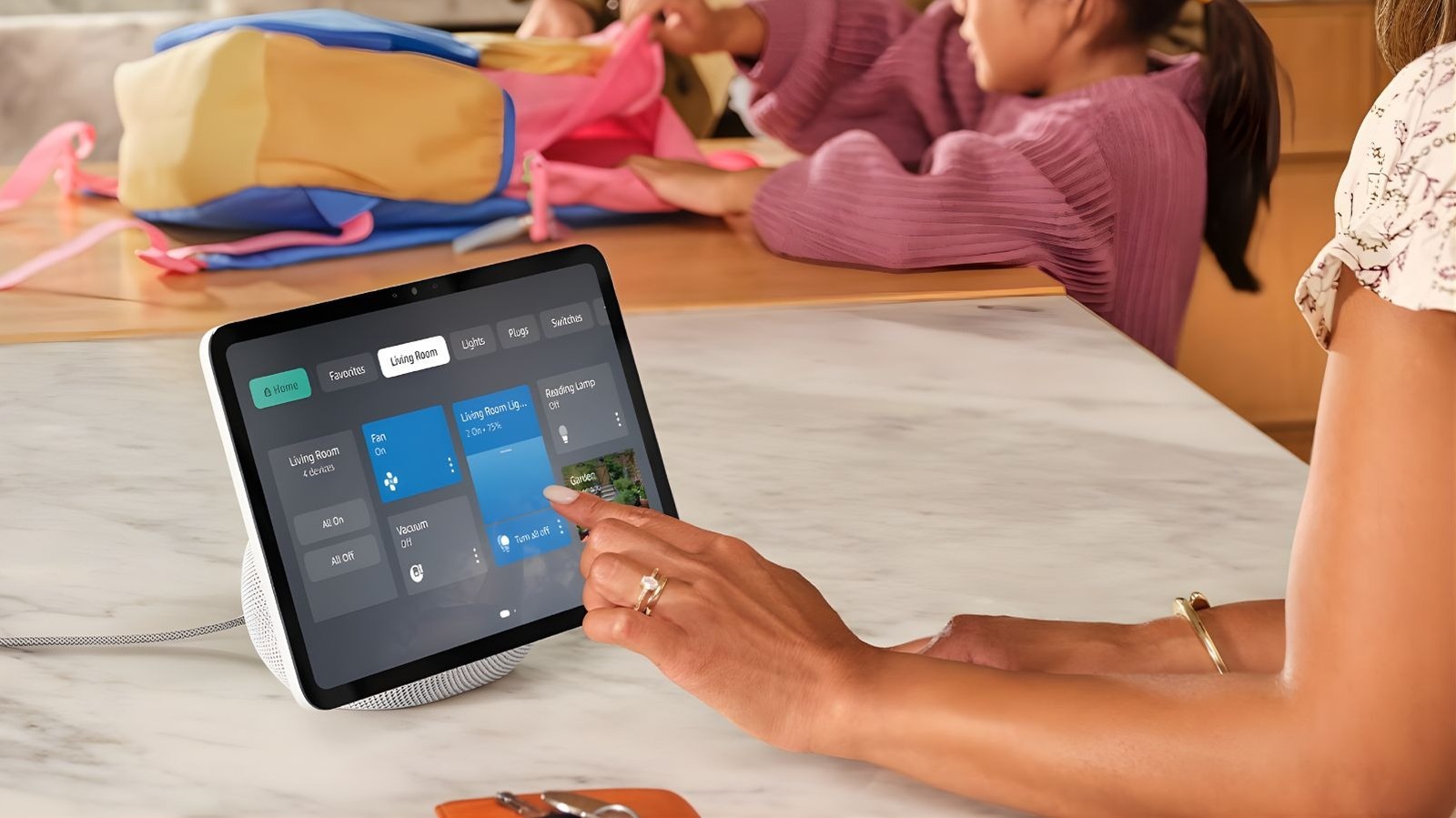
Apple’s Home Hub appears positioned to challenge Amazon Echo Show and Google Nest Hub with a distinctly Apple approach. The device will feature a 7-inch display with an iPad-like design, available in two configurations: a wall-mounted version and another with a speaker base similar to HomePod mini, according to MacRumors.
What sets this apart from competing products is the custom operating system codenamed “Pebble,” which will run without an App Store but include Apple apps as widgets for seamless integration. Think of it as a purpose-built interface rather than a stripped-down tablet experience. The hardware foundation includes a built-in camera for video calls, internal speakers, and a rechargeable battery, as detailed by Gadget Hacks.
Perhaps most impressively, the device will use presence detection to automatically adjust the interface when someone approaches. This isn’t just motion sensing—the system can potentially turn on lights and adjust temperature based on who’s detected in the room. This adaptive interface represents a significant evolution beyond current smart displays, which largely function as static control panels with limited contextual awareness.
The smart camera that could change everything
Apple’s rumored smart camera represents their first serious foray into home security hardware. Industry analyst Ming-Chi Kuo suggests the company plans to mass-produce a HomeKit-enabled wireless IP camera in 2026, according to Live Mint.
The camera is designed to integrate seamlessly with other Apple hardware through wireless connectivity, offering significantly improved user experience through Apple ecosystem integration, Apple Intelligence, and Siri. What makes this particularly compelling is the potential for extended battery life—possibly lasting several months or even a year—combined with advanced features like facial recognition and infrared sensors for accurate person detection.
The real game-changer lies in the automation possibilities this enables. Unlike traditional security cameras that simply record and alert, Apple’s device could orchestrate entire home responses based on who it recognizes. Picture a camera that automatically turns off lights when it detects the last person leaving a room, or plays personalized music when it recognizes a family member entering the living space—transforming home security hardware into a comprehensive automation hub.
AI and ecosystem integration: the real differentiator
The true power of Apple’s smart home push lies in its AI integration and ecosystem connectivity. Apple’s new Siri will incorporate large language models to handle complex queries and complete sophisticated tasks, with the hardware designed around App Intents—a system that lets AI control applications and tasks, as reported by Gadget Hacks.
This enhanced Siri will run on Apple’s Private Cloud Compute servers, ensuring privacy while delivering powerful capabilities. Unlike current voice assistants that often struggle with context, this new system should understand complex, multi-part requests and execute them across multiple apps and devices simultaneously. Imagine saying “Good night” and having the system automatically lock doors, adjust the thermostat, turn off lights throughout the house, and set your alarm—all through natural conversation.
The devices will leverage Matter support, which reduces barriers to entry by making more affordable, compatible products available while enabling faster response times through local network processing. What’s particularly clever about Apple’s approach is addressing the current smart home preference gap: research shows hubs were generally less preferred compared to voice commands or phone apps, but Apple’s adaptive interfaces and presence detection could bridge that usability divide.
Timeline and market positioning
Apple is targeting a March-April 2026 launch window for their smart home display, according to Gadget Hacks. The company is considering pricing around $350 for the basic model, positioning it competitively against existing smart displays while leveraging Apple’s premium brand positioning.
Bloomberg’s Mark Gurman and other industry sources have confirmed Apple’s plans to explore the smart home segment starting with these accessories, with production potentially beginning in 2026. The extended development timeline suggests Apple is taking their characteristic approach of entering a market only when they can offer meaningful differentiation rather than rushing to compete on features alone.
The delayed launch appears strategic rather than problematic. Studies show Apple was preferred most overall in smart home user experience comparisons, ranking ahead of both Google and Amazon, suggesting strong market potential despite their currently limited lineup of just Apple TV and HomePod. This user preference advantage, combined with their advanced AI integration timeline, positions Apple to potentially leapfrog existing smart home platforms rather than merely match them.
What this means for the smart home landscape
Apple’s entry into dedicated smart home hardware could significantly reshape the market dynamics. The combination of premium hardware, deep ecosystem integration, and advanced AI capabilities positions these devices to compete directly with established players while offering unique advantages that address current market limitations.
The focus on privacy through on-device processing for facial recognition and activity detection aligns with Apple’s broader privacy emphasis, potentially appealing to security-conscious consumers who’ve been hesitant about smart home adoption. Matter support and enhanced Thread capabilities suggest Apple is serious about interoperability, addressing one of the biggest pain points in current smart home setups where device compatibility remains frustratingly fragmented.
Most significantly, Apple’s approach could solve the “hub problem” that has plagued the smart home industry. By combining presence detection, adaptive interfaces, and sophisticated AI that can understand natural conversation, these devices might finally deliver on the smart home promise of seamless, intuitive control. With iOS 26.2’s code references and feature additions serving as building blocks, Apple appears ready to leverage its existing user base and ecosystem strength to capture significant market share while fundamentally advancing what smart home technology can accomplish.
link

:max_bytes(150000):strip_icc()/GettyImages-1220602415-869d569919b24829b21868f530a8207f.jpg "The 1980s Trend Designers Hope Never Comes Back")