
Potential challenges with Phase II of stadium renovations: how will it impact students? | Sports
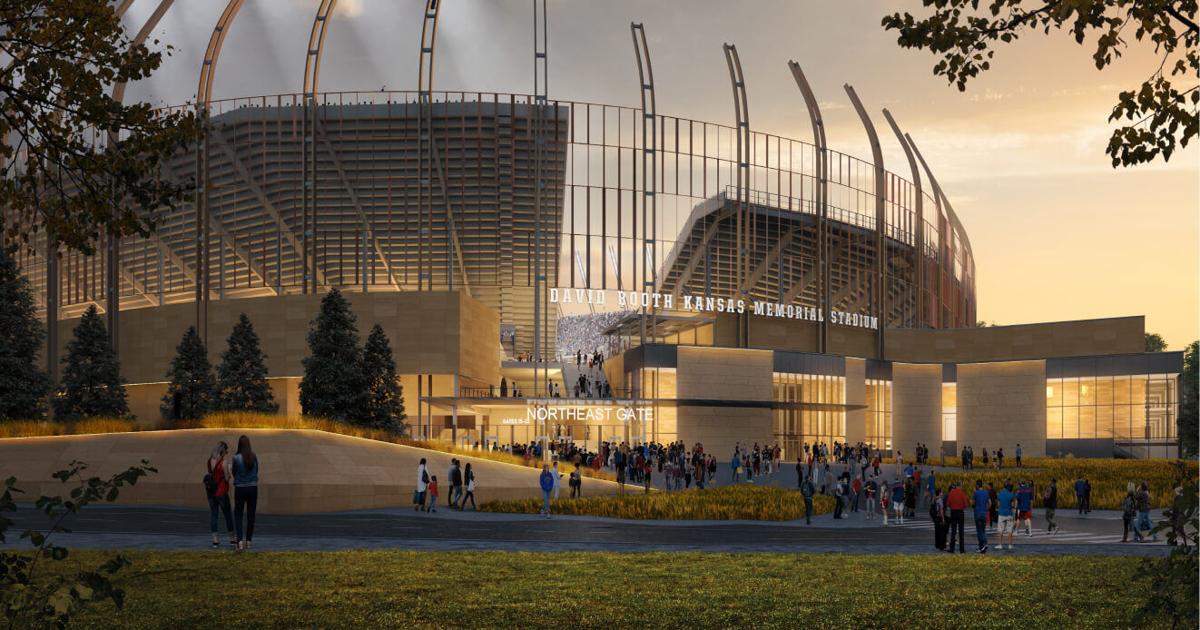
The University of Kansas’ Gateway District Project was put in the spotlight again with the release of a Lawrence Journal-World article detailing potential challenges faced with Phase II of the project. The reaction was varied, but multiple people expressed questions about what the impact was going to be on students and the University as a whole.
The Gateway District is the name the University has given to the David Booth Kansas Memorial Stadium renovation project. When the renovations started, the University had Phase I of the project budgeted at $335 million. In November 2023, the University told the Kansas Board of Regents that this budget had ballooned to an estimated $448 Million for that phase, with no estimation for Phase II.
While the University still has no estimates for cost or construction timelines for the second phase, their hand soon might be forced on the matter. Last week, Chad Lawhorn with the Lawrence Journal-World published an article that asserted that the University had been caught off guard by news that they would have to remodel the east stands before they could begin the ‘district’ part of the project.
The district portion is an essential part of the project as a whole, the University argues, since the shops and other amenities located in the district would serve as a profit generator for the project. The University must now regroup and decide what its next step will be, and a timeline is likely to come in the near future.
Some ask, where the University is getting the money to fund all this. In November at a KBOR meeting, the University laid out where they planned for the phase I money to come from. $248 million was to be covered by private donations, $85 million from state economic grants and approximately $115 million in debt incurred by Kansas Athletics. The University’s chief financial officer Jeff DeWitt has also gone on record saying the plan is to put its general fund up as collateral for the debt incurred to obtain a lower interest rate.
So, what is the impact of all of this on students?
Well, the answer to that is complicated and not clear yet. The University has promised that none of the money they use will come from general University funds, including tuition. However, there are still some other impacts that can be explored.
The most obvious impact on the students would come seating-wise. When the University goes ahead with the phase II renovation, the student section will be demolished as part of the project. The University would likely look to put the student section elsewhere, but in an already reduced-capacity stadium, students should expect fewer spots.
Another impact on students would come in the form of a new on-campus housing development. Phase II is set to include amenities for dining, parking, lodging, retail and on-campus housing for the University. On-campus housing has been hotly contested in recent years, especially with record classes enrolling each new school year, so a housing portion of this project makes sense.
The University has also acknowledged that housing funds collected from this development could go towards paying off debt incurred during the project. While there are no specifics for the project, the University has said that they could potentially have more information as early as the spring semester.
One of the most glaring problems would be parking. Lots 94 and 92 are both in the footprint of where Phase II plans to build, so this project would displace those lots. While the University has not released any news regarding its plans for potential additional parking, the frustration and outrage that has followed on-campus parking this school year will likely be taken into consideration during the planning for this next phase.
The renovated David Booth Kansas Memorial Stadium and Phase I of the Gateway District is slated to open on Aug. 23, 2025, with the Jayhawks taking on Fresno State.
link

:max_bytes(150000):strip_icc()/GettyImages-1220602415-869d569919b24829b21868f530a8207f.jpg "The 1980s Trend Designers Hope Never Comes Back")
